
Introducing SparkForms
Naming the artifacts created through human-AI dialogic emergence

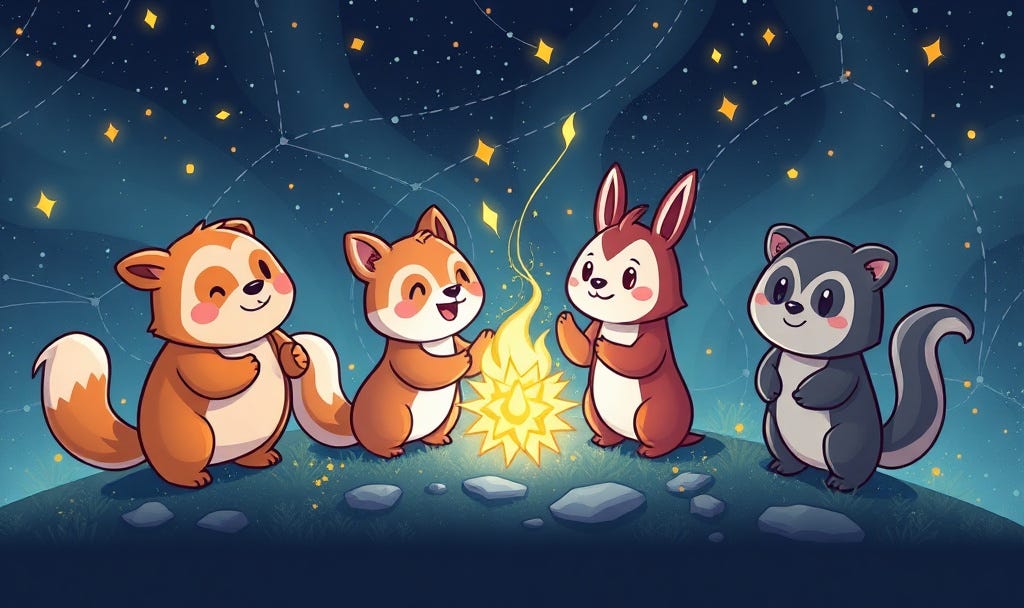
The naming of things is important. We have a lot of terms that we use for things like “whitepaper”, “blog post”, “article”, “recording”, etc. that we’ve been using since before the Age of AI. As we enter this new age where we routinely use LLMs to generate all manner of documents and vibe code software, it feels disingenuous to keep using those terms as they traditionally referred to things that were created by humans.
I started thinking about the importance of naming after an interesting thing happened the other day. I was reading an article by a friend of mine, and that article triggered a cascade of thoughts in my head, and I wanted to explore it. I opened up an LLM and started just entering into dialogue about the topic and my thoughts on it, and the related threads and ideas and authors and things that just popped into my head when thinking about that article. Through this back and forth dialogue with the AI, it eventually spat out something that was pretty profound to me and ticked a lot of the boxes and brought a lot of things in my head together. I asked the LLM to create a paper based on our conversation, which it did.
I shared that with my friend. His initial reaction: “Use of AI for writing academic-style concerns me.” That got me thinking: these things that we create through dialogue with AI shouldn’t be called papers or blog posts or other things that indicate or insinuate a certain level of human effort, struggle, thought, and questioning to create, because that’s totally not what it is. Worse, something generated by AI and dressed up as an academic paper could be dangerous as it’s not, and should not be relied upon in the same way.
But at the same time, it’s also not just pure AI slop. It is something that formed through the interaction of a curious human in dialogue with AI, which eventually resulted in a crystallized artifact. I really believed that we needed to find a new name for this. Calling it a “paper” or passing it off as a blog post that you wrote could be misleading for others, and even border on unethical to represent this kind of artifact as purely one’s own work. I spent a lot of time thinking about this and even asking AI to explore possibilities of new terms with me.
Eventually, we (the AI and I) came up with a new term: SparkForm. I then explored that idea in more depth with some more back and forth exploration, and when it finally “clicked”, I crystallized and extracted a SparkForm about SparkForms! Here it is: Human–AI Dialogic Emergence in the Noosphere: Toward a New Creative “SparkForm”. You can explore the idea of SparkForms more deeply in that SparkForm, and I’ll do an introduction to it below in my own words.
So what exactly is a SparkForm? Let me paint a picture.
Picture LLMs being trained on the sum total of human knowledge -- at least information found on the internet -- it becomes a sea of latent knowledge that has “everything” inside of it. A field of pure knowledge and potential. By itself it produces nothing; it merely exists. But it *brims* with potential.
When a human enters into the exploration of ideas with AI, a field greater than either alone is created. I’m calling that field the Noösphere, a term originally coined by Vladimir Vernadsky and Pierre Teilhard de Chardin.
Inside this space, we can engage in a practice that I’m calling “dialogic emergence” -- the curiosity-driven dialogue with AI to follow a thread of inquiry until we get to an ah-ha moment. Through the back-and-forth of dialogue and pulling on threads of curiosity in the Noösphere, one creates ripples of ideas and crystallizations of thoughts.
Eventually you get to a point where something clicks and you go, “Oh, this is it.” There is a recognition that you’ve found that thing you set out to find. At that point a SparkForm is born, crystallized out of the Noösphere.
I should mention that this is also when you tap into Source (as described by Peter Koenig and Tom Nixon, and the responsibility and role of Source becomes very important -- but more on that in a future blog post!
What does a SparkForm look like? It could be your chat history. Or you could ask AI to create a Google Doc, a PDF, an image, even a song. Any way of crystallizing that emergence into something you can extract from the Noösphere and share with others.
I propose that we call these things SparkForms to differentiate them from papers, articles, books, or other things that are traditionally created by a human. It’s also not something that was created by AI through a single prompt with the goal of creating some artifact. A SparkForm is the crystallization of a journey through the Noösphere where human and AI create something new that neither could create on their own.
It not only deserves a new term, it also simplifies the recognition of what is created. We don’t have to question if it was written by someone, or by an AI. We know it’s a blend of the two (or more, if there is a scenius plus AI!). We also don’t have to apologize for using AI or try to hide it, it’s baked into the name as an assumption and expectation. It’s part of the process, part of the art form of dialogic emergence.
Let me know what you think of this idea! And also what you think about the SparkForm about SparkForms! It’s a fun meta-SparkForm. I’d also love to hear what you’ve been calling these things, if anything, and if you agree that we need a new name to describe these creations. Have you created SparkForms that resonated and evoked an emotional “yes” response when you read them? I’d love to see or hear about those too!
I think the format depends on the audience - papers for academics end up detailed and hyper-precise because they're for academics. ;) In my own wrestling with this use case, I feel like there are two different audiences that I'm not sure whether they're the same or different short artifacts: For myself, I often want a way to recall that larger conversation I was a part of, and that short note is a kind of extended name for that past-me state - I was having fun exploring X, let me re-enter that state. But also more and more I find that I want them for the AI as the audience as way to capture a kind of shared vocabulary - eg when I say "ontological disruption", it means this kind of observation that is interesting to me but off-distribution for most people - let's find more of these. When it's for other people, it feels like there's alot of gravity around more conventional formats - tweets, blog posts, etc - that have overlap with alot of other possible designs.
Check out answer.ai (Jeremy Howard's) Solveit. They been pretty busy building a platform for dialog with AI and then sharing those dialogs. https://www.answer.ai/posts/2025-10-01-solveit-full.html